
Two recent publications in Solid-State Electronics from CEZAMAT WUT address RRAM technology applications. The studies combine experimental investigation and modeling to support reliable memory operation and hardware security applications, strengthening the technological foundations of emerging non-volatile memory solutions.
Emerging memory technologies like RRAM offer promising advantages for next-generation memory, in-memory computing, and hardware security. Stabilizing switching behavior for reliable memory operation is crucial as well as harnessing intrinsic stochasticity. Improving our understanding of conductive‑filament dynamics, compliance‑current effects, and switching properties enables progress in both domains, leading to more robust memory devices as well as stronger, more resilient hardware security mechanisms.
The first study focuses on the impact of compliance current on resistive switching properties in RRAM devices. It analyzes physical device behavior, focusing on conductive‑filament formation, electrical characteristics, and switching stability under different compliance‑current conditions.
The second study presents a modeling approach for RRAM-based Physical Unclonable Functions (PUFs). The authors develop a device-level model capturing intrinsic device variability. It enables evaluation of RRAM suitability for hardware security applications such as authentication and cryptographic key generation.
Stochastic variations that hinder memory reliability form the basis for hardware security primitives such as physically unclonable functions (PUFs). To exploit this randomness effectively, it must be accurately statistically modeled, predicted, and integrated into robust PUF architectures that preserve device uniqueness, uniformity, and reliability under real-world operating conditions. Achieving this balance requires a deep understanding of both the physical switching mechanisms of RRAM and its variability.
In general, the work leverages the stochastic properties of devices to develop and evaluate hardware security architectures, demonstrating how variability becomes a feature rather than a drawback.
Together, these works connect experimental device physics with higher-level modeling and application requirements.
The research directly benefits from advanced micro- and nanoelectronic research infrastructure and process know-how developed within the FAMES Pilot Line ecosystem. Access to state-of-the-art capabilities and expertise in emerging semiconductor devices enabled analysis and validation of selected concepts relevant to industrial use cases.
These results support FAMES objectives by strengthening the understanding of properties of emerging memory devices and showing the potential application concepts. A good understanding of device physics and validated device models is essential for transferring technologies from research to pilot-line manufacturing and future industrial adoption.
The findings are applicable to a reliable eNVM application in hardware security concepts. They provide a foundation for further research on process optimization, circuit-level integration, and industry-driven R&D within the FAMES ecosystem.
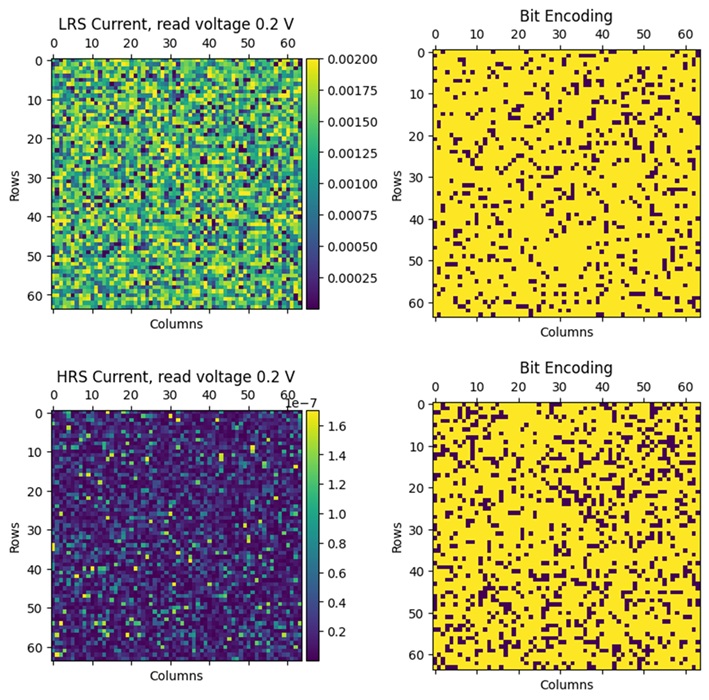
J. Lespiaux et al, ECS Prime Trans. 114 271 (2024). doi: 10.1016/j.sse.2025.109267
Wiśniewski, P., Jeżak, P., Małkowski, A., Kądziela, A., Krzemiński, J., & Mroczyński, R. (2026). Investigation of compliance current effect on resistive switching properties in Ag/SiOx/Cr RRAM devices. Solid-State Electronics, 231, 109288. doi: 10.1016/j.sse.2025.109288
Piotr Wiśniewski (CEZAMAT – Warsaw University of Technology), Kamil Ber (CEZAMAT – Warsaw University of Technology)

Website designed and made by Perceptiom and FAMES

FAMES is a European Union’s Horizon Europe Research and Innovation programme
Website designed and made by Perceptiom and FAMES

Website designed and made by Perceptiom and FAMES
Request submitted!
Thank you for your registration. You will receive a copy by email. We will be getting in touch with you shortly to confirm or not your registration to the Winter School.
If you encountered an error or did not receive a copy (please check your spam), contact us.
Registration submitted!
Thank you for registering for the FAMES Annual Event!
Please note that all participants must also register for EFECS 2026 free of charge: here
See you soon!
If you encounter any issues, please contact us.
Annual Event – FAMES Workshop at EFECS
4 Dec. 2026
Free
All FAMES Partners undertake to respect their obligations in application of regulations in force and, especially, regulation (EU) 2016/679 of the European Parliament and of the Council of 27 April 2016, on the protection of natural persons with regard to the processing of personal data and on the free movement of such data (referred to as “GDPR”).
Ferrite Circulators: Theory, Design and Simulation
26 Nov. 2026
Cost: 150€
All FAMES Partners undertake to respect their obligations in application of regulations in force and, especially, regulation (EU) 2016/679 of the European Parliament and of the Council of 27 April 2016, on the protection of natural persons with regard to the processing of personal data and on the free movement of such data (referred to as “GDPR”).
Keep up to date with the latest news from FAMES
All FAMES Partners undertake to respect their obligations in application of regulations in force and, especially, regulation (EU) 2016/679 of the European Parliament and of the Council of 27 April 2016, on the protection of natural persons with regard to the processing of personal data and on the free movement of such data (referred to as “GDPR”).
Request submitted!
Thank you for your registration. You will receive a copy by email. We will be getting in touch with you shortly to confirm or not your registration to the Ferrite Circulators: Theory, Design and Simulation School.
If you encountered an error or did not receive a copy (please check your spam), contact us.
FAMES European FD-SOI Design School (EFDS)
FAMES European FD-SOI Design School (EFDS)
January 25-29, 2027
Training costs: 1400€
All FAMES Partners undertake to respect their obligations in application of regulations in force and, especially, regulation (EU) 2016/679 of the European Parliament and of the Council of 27 April 2016, on the protection of natural persons with regard to the processing of personal data and on the free movement of such data (referred to as “GDPR”).
Request submitted!
Thank you for your request. You will receive a copy by email. We will be getting in touch with you shortly.
If you encountered an error or did not receive a copy (please check your spam), contact us at open-access-chair@fames-pilot-line.eu.
FAMES Open-Access Call User Request
Please note that your answers will help us establish the eligibility of your request.
All FAMES Partners undertake to respect their obligations in application of regulations in force and, especially, regulation (EU) 2016/679 of the European Parliament and of the Council of 27 April 2016, on the protection of natural persons with regard to the processing of personal data and on the free movement of such data (referred to as “GDPR”).
Spontaneous User Request
Please note that your answers will help us establish the eligibility of your request.
All FAMES Partners undertake to respect their obligations in application of regulations in force and, especially, regulation (EU) 2016/679 of the European Parliament and of the Council of 27 April 2016, on the protection of natural persons with regard to the processing of personal data and on the free movement of such data (referred to as “GDPR”).
Contact

Susana Bonnetier (CEA-Leti)
For inquiries or problems regarding the Open Access/Spontaneous Request, you can contact us directly.
Trainings
Annual call