GUIDELINES FOR OPEN ACCESS

FAMES PILOT LINE

User Guidelines and Procedures

Download as pdf

The purpose of this FAMES Pilot Line User Guidelines and Procedures document is to describe to Potential Users, in detail, the procedure for accessing the FAMES Pilot Line R&D Services. The document presents general Technology Portfolio content, explains the access process for each of the access modes, defines the governing bodies of the process, and presents User selection criteria, general cost elements and general intellectual property conditions.

Summary

1. OVERVIEW

The FAMES Pilot Line is a technical infrastructure that offers European semiconductor stakeholders from industry, research, and academia access to a unique palette of advanced FD-SOI semiconductor technologies with embedded non-volatile Memories, RF components, 3D integration and PMIC components. The R&D Services offered by the FAMES Pilot Line include chip design, prototyping, advanced manufacturing, characterization and testing capabilities.

The FAMES Pilot Line is distributed among a consortium of 11 public research partners (listed in alphabetical order, they are: CEA-Leti, CEZAMAT-WUT, Fraunhofer, Grenoble INP, Imec, SAL, SiNANO, Tyndall, UCLouvain, Universidad de Granada and VTT) from 8 European countries (France, Poland, Germany, Belgium, Austria, Ireland, Spain and Finland). Each partner brings a key and complementary skill to maximize the impact of the FAMES Pilot Line.

Figure 1. FAMES Pilot Line Consortium

The FAMES Pilot Line will strengthen the current FD-SOI ecosystem and support key European stakeholders throughout the semiconductor value chain and, in particular, will leverage the highly differentiating FD-SOI based solutions to address the rapid growth of low power, connectivity and security integrated circuits for automotive, IoT and smart mobile devices. This initiative aligns with the EU Chips Act whose goal is to bolster the EU’s semiconductor industry and support European technological sovereignty. The Chips Joint Undertaking, or Chips JU, is a European tri-partite partnership that is boosting the development and adoption of advanced nano-electronic chip technologies and systems manufactured in Europe. In line with the goals of the EU Chips Act, the Chips JU and the relevant participating States are supporting the FAMES Pilot Line by co-financing crucial pieces of equipment and R&D work.

The FAMES Pilot Line Partners reach out to Potential Users by way of dedicated workshops, talks and booths at the major electronics conferences and forums and through Design Platforms, Competence Centres and Digital Innovation Hubs, to provide support in accessing the pilot line. Email assistance is also provided via the FAMES PL website.

Two access modes have been defined, a Spontaneous Request mode whereby Potential Users can request access to the FAMES PL R&D Services via the FAMES website or by contacting a FAMES Partner, and an Open Call Request mode whereby Potential Users can request access to specific R&D Services during annual Open Calls via the FAMES website.

The purpose of this FAMES Pilot Line User Guidelines and Procedures document is to describe to Potential Users, in detail, the procedure for accessing the FAMES Pilot Line R&D Services. The document presents general Technology Portfolio content, explains the access process for each of the access modes, defines the governing bodies of the process, and presents User selection criteria, general cost elements and general intellectual property conditions.

Figure 2. Open Access mechanisms for the FAMES Pilot Line

2. General Technological Portfolio Content

The FAMES Pilot Line R&D Services will allow Users to access:

  • Pathfinding PDKs for IC circuit design and assessment;
  • PDKs allowing access to Multi-Project Wafers (MPW) and dedicated wafers;
  • ADKs and related tests structure data to evaluate PMIC technological options.

Users will be able to evaluate FAMES Pilot Line technologies including:

  • FD-SOI 10nm and 7nm;
  • Embedded non-volatile memories;
  • RF components;
  • 3D monolithic and heterogeneous integration modes;
  • PMIC components.

Users will also be able to gain access to:

  • Specific FAMES Pilot Line process steps, modules, process integration flows, specific results from demonstrators and, in some specific cases, access to manufacturing and characterization equipment via Spontaneous User Requests;
  • Training programs to understand the benefits, and how to design and evaluate the FAMES Pilot Line technologies.

Currently available R&D Services can be found on the Open Access page.

3. USER ACCESS GOVERNANCE

The FAMES Pilot Line Open Access will be governed by the Open Access Committee who will

  • Benefit from the recommendations of technical Dedicated Teams and
  • Assign a Lead Partner to each User Request.

3.1 The Open Access Committee (OAC)

The OAC ensures transparency in the selection of User Requests submitted either in response to the Open Calls or as Spontaneous User Requests. The OAC makes sure that the User selection process is carried out in a non-discriminatory and fair way and according to the Chips JU and National policies and procedures. The OAC is composed of representatives of nine FAMES Consortium Partners (namely CEA-Leti, CEZAMAT-WUT, Fraunhofer, Imec, INP-UGA, SAL, Tyndall, UCL, VTT). Representatives of the Chips JU and/or representatives of the national public authorities of FAMES Partner States who are represented in the Chips JU Governing Board, will be invited to the Open Access Committee meetings.

The Open Access Committee has the overall responsibility for defining the Open Call content and schedule. The OAC also decides on the eligibility of Open Call User Requests using criteria defined in compliance with European Commission and Chips JU and National policies and procedures. The OAC will make the final selection of Open Call User Requests based on eligibility criteria, the technical recommendations of the Dedicated Team (namely, feasibility and FAMES PL capacity uptake) and, in the event of a User Request overflow, on ranking criteria (see section 5 below).

3.2 The Dedicated Team (DT).

The Dedicated Team makes technical recommendations to the OAC and the LP after evaluating the technical feasibility of the User Requests and estimating the amount of FAMES Pilot Line capacity they will require. The Dedicated Team is made up of technical experts in the domains of the FAMES R&D Services, and its composition may vary as a function of the R&D Services offered in the yearly Open Calls or requested by the Users through Spontaneous User Requests.

In the case of Open Calls, Dedicated Teams will be predefined by the OAC and will include experts from the Partner consortium knowledgeable in the specific R&D Services of each Open Call. In the case of Spontaneous User Requests, once the Lead Partner is assigned by the OAC, he or she will designate an ad hoc Dedicated Team composed of FAMES Consortium experts able to evaluate the User Request and build an R&D Technical and Financial Proposal. This ad hoc DT may consult other experts from the FAMES Consortium, as needed, to complete their tasks.


3.3 The Lead Partner (LP)

The Lead Partner is one of the FAMES Partners, is appointed or confirmed by the Open Access Committee and is the main contact point of a Potential User. Typically, the Lead Partner will be the FAMES Partner carrying out the largest part of the work in a User Project, but the OAC will also take into account the FAMES PL capacity at the time of the request, and the fair distribution of User Requests among the Consortium Partners. In the case of Spontaneous User Requests, the OAC may delegate the eligibility evaluation of a User Request to the Lead Partner.

The Lead Partner will sign an NDA with the Potential User in the name and on behalf of the FAMES Consortium. He or she will also prepare the R&D Technical and Financial proposition, with the help of a Dedicated Team as needed, and present it to the User. In the event that a PDK/ADK/DRM is needed by the User to evaluate a technology or implement a circuit and/or demonstrator design, the Lead Partner shall put the User in contact with the Partner who owns the PDK/ADK/DRM. The Partner that grants access to its PDK/ADK/DRM will sign a DKLA in its own name directly with the User.


3.4 Supporting Partner(s)

The Supporting Partner(s) are FAMES Partners other than the Lead Partner that participate in a Multi-Partner User Project (see section 7). The Supporting Partner(s) carry out some specific project tasks the Lead Partner cannot provide. The Lead Partner enters into a contract with the Supporting Partner(s) and remains the main contact between the FAMES Partners and the User.

4. USER ACCESS TO THE FAMES PILOT LINE R&D SERVICES

Accessing the FAMES Pilot Line can be done in two ways: by responding to annual Open Calls or by submitting a Spontaneous User Request. The different access workflows are presented below.

4.1 Responding to Annual Open Calls

Annual Calls will be open each year during the 2025 to 2028 period. The first call is expected to open mid-March 2025 and close approximately 2 months later.

Generalities

User Requests must be submitted electronically via the website and received before the Open Call closing date and time. Failure of a request to arrive before the deadline for any reason, including communications delays, will be final. A User may modify his or her request after a first submission, provided the call deadline has not passed. Only the last version of the User Request received before the call deadline will be considered in the evaluation.

An acknowledgment of receipt will be emailed automatically to each Potential User having submitted a request via the FAMES website. Sending an acknowledgement of receipt does not imply that the User Request has been accepted as technically feasible nor selected, it is just a confirmation that the User Request has been registered.

Open Call User Request via the FAMES website

  • The process starts when a Potential User submits an Open Access User Request form (see Annex 13) via the FAMES website;
  • The Open Access Committee evaluates the eligibility of the User Request and the Dedicated Team evaluates the technical feasibility and approximate FAMES Pilot Line capacity uptake of the User Request;
  • Based on the eligibility criteria, the technical recommendations of the DT and the ranking criteria (see section 5 below), the OAC will define the list of eligible User Requests by rank. The OAC will notify the Potential Users whose projects were not selected and give the reason for the refusal;
  • If the number of eligible requests exceeds the FAMES Pilot Line capacity, the OAC will make a selection of User Requests by rank, and will place the other User Requests on a waiting list. Users whose requests are on the waiting list will be duly informed. The waiting list will be reviewed two months after the Call closing date and, if possible, additional User Requests will be added at that time to the list of selected User Requests. All Potential Users on the waiting list will be contacted at that time, and informed of the acceptance or refusal of their requests;
  • For each selected User Request, the OAC assigns a Lead Partner. A formal R&D Technical and Financial Proposition is drafted by the Lead Partner. An NDA will be signed between the Lead Partner and the Potential User at this time and for this purpose;
  • The finalized R&D Technical and Financial Proposition is presented to the User;
  • Once the Proposition is accepted and a User Agreement is signed, the User Project can be launched;
  • The Lead Partner informs the OAC of the new Open Call User Project for tracking purposes;
  • If an agreement is not reached between the Lead Partner and the User, the Lead Partner informs the OAC and archives the request for one year.
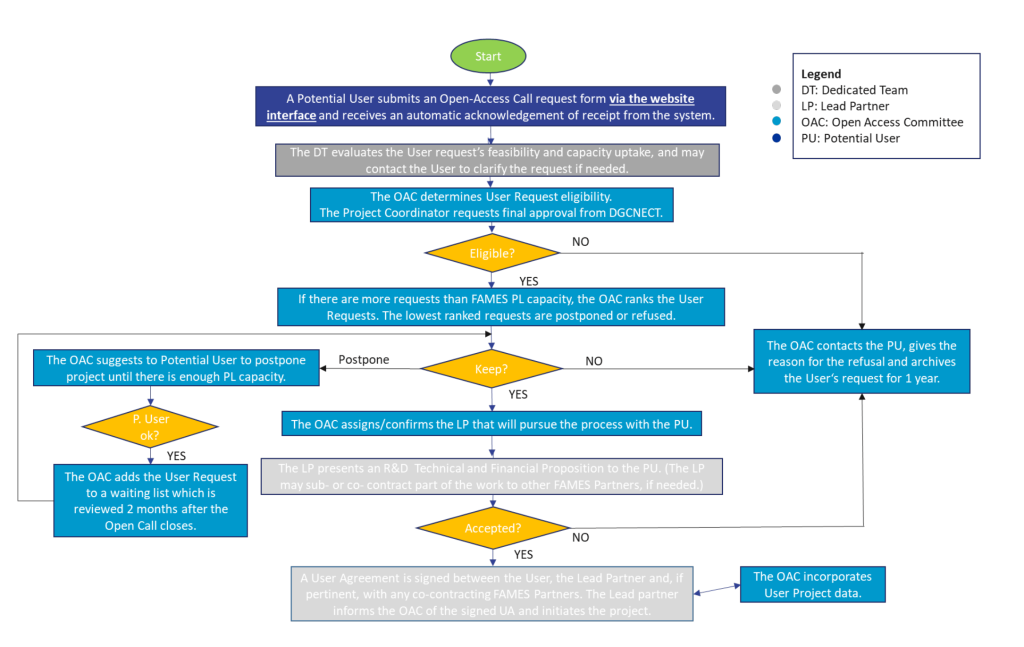
Figure 3. Open Call User Request Selection Flowchart

4.2 Submitting a Spontaneous User Request

At any time, a Potential User can submit a Spontaneous User Request to the FAMES Pilot Line. The submission process is similar to the one for Annual Open Calls except that a Spontaneous User Request can be made via the FAMES website or by contacting one or more FAMES Partners.

Spontaneous User Request via the FAMES website

  • The process starts when a Potential User submits a Spontaneous User Request form (see Annex 13) via the FAMES website;
  • The Open Access Committee (OAC) evaluates the eligibility of the User Request and, if it is eligible, appoints a Lead Partner to the User Request taking into account any preferences expressed by the User in the access form;
  • The Lead Partner contacts the User ASAP for a first exchange. The Potential User and the LP may decide on a new meeting date to clearly understand the Potential User’s needs. An NDA may be signed at this time for this purpose;
  • The Lead Partner designates an ad hoc Dedicated Team to evaluate the initial technical feasibility and FAMES Pilot Line capacity uptake of the Spontaneous User Request. This ad hoc DT may consult Experts from the pool of FAMES consortium experts as needed to complete their tasks;
  • The Lead Partner contacts the Potential User to co-construct an R&D User Project corresponding to the Users’ needs. If not done before, an NDA is signed at this time;
  • Once the Lead Partner and the Potential User agree on the technical content of the User Project and a tentative schedule, an R&D Technical and Financial Proposition is drafted by the Lead partner and presented to the Potential User;
  • Once the R&D Technical and Financial Proposition is accepted and a User Agreement is signed, the User Project can be launched;
  • The Lead Partner informs the OAC of the new User Project for tracking purposes;
  • If an agreement is not reached between the Lead Partner and the Potential User, the Lead Partner informs the OAC and archives the request for one year.

 Spontaneous User Request made directly to a Partner

  • The process starts when a Potential User contacts a FAMES Partner to request access to the FAMES Pilot Line R&D Services;
  • The FAMES Partner informs the Open Access Committee of the arrival of a new Spontaneous User Request;
  • The OAC or the Partner contacted by the User evaluates the eligibility of the Spontaneous User Request and, if it is eligible, confirms the Lead Partner or assigns a new LP to address the User Request;
  • The rest of the process is the same as if the Potential User had submitted the Spontaneous User Request via the FAMES website.

Figure 4. Custom User Request Selection Flowchart

User Request via Competence Centres, Design Platforms and Digital Innovation Hubs

When a Competence Centre, Design Platform or Digital Innovation Hub is contacted by a Potential User, it will support the Potential User in submitting a Spontaneous or Open Call User Request, or in contacting a FAMES Partner directly.

5. SELECTION CRITERIA

The use of the Pilot Line is subject to fair, reasonable and non-discriminatory terms and conditions. All access requests submitted by Potential Users will be evaluated for eligibility, technical feasibility and pilot line capacity uptake. In the event that too many eligible requests are received relative to the capacity of the line, ranking criteria will be used to prioritize the different User Requests. The eligibility and ranking criteria are listed below. The feasibility of a project and its capacity uptake will be evaluated by relevant experts of the Dedicated Team(s). Additionally, because the FAMES Partners are all research and knowledge dissemination organisations, the amount of economic activities they carry out must not exceed 20% of their overall annual capacity. This may limit the number of economic requests accepted by the FAMES Pilot Line.

Eligibility Criteria

The Partners have agreed with the Chips JU that access to the pilot lines should primarily be reserved to entities established in Participating States of the Chips JU, meaning EU Member States, EEA countries and those countries that have been associated to Horizon Europe or to the Digital Europe Strategic Objective 6 (under which the pilot lines are funded). In determining access to the pilot lines for entities established in any Participating State but controlled from third countries that are not Participating States of the Chips JU, the Hosting Consortium must take into consideration two main criteria: EU added value and Economic security considerations. Entities from third countries may also be granted access when they are contributing to jointly funded research and innovation activities between the Union and that third country and/or access is foreseen in international cooperation agreements of the European Union concerning semiconductors such as those defined in Digital Partnerships or Trade and Technology Council agreements of the Union with third countries.

Therefore, Potential Users must comply with the following criteria in order to gain access to the FAMES PL:

  • Be a legal entity (public or private);
  • Be established in an eligible country, meaning EU Member States, EEA countries, countries that have been associated with Horizon Europe and countries associated with the Digital Europe Strategic Objective 6 under which the FAMES Pilot Line is funded.
  • Users controlled from third countries that are not Participating States of the Chips JU must satisfy the following criteria:
  • Provide EU added value (contribution to the objectives of the Chips Act, expanding the knowledge base and capabilities of the FAMES Pilot Line Consortium…);
  • Satisfy economic security considerations (when considering risks to European semiconductor supply chains, physical and cybersecurity of the pilot line, security and leakage of sensitive semiconductor technology…);
  • Comply with confidentiality obligations and IP Rights (to avoid potential risks of infringement of IP, unauthorized disclosure of trade secrets and IP rights, security, confidentiality, or the leakage of sensitive emerging technologies within the semiconductor sector).
  • Entities from third countries may also gain access if
  • They contribute to jointly funded research and innovation activities between the Union and that third country, and/or access is foreseen in international cooperation agreements of the European Union concerning semiconductors.

In all other cases, eligibility will be decided in accordance with European Commission/Chips JU criteria and national guidelines.

Additional legitimate criteria that would make a User Request non-eligible for access to the FAMES Pilot Line may include:

  • Major risk of tool contamination from wafer imports identified by one or more FAMES Partners;
  • Executing the User Project would be against the legitimate interests of one or more of the Partners;
  • Potential User activities are prohibited under mandatory regulations such as export control regulation or could expose one or more FAMES Partners to the risk of becoming subject to sanctions under mandatory laws;
  • Potential User activities are not in line with EU, international and national laws on ethical principles and the respect of basic EU values, such as respect for human dignity, freedom, democracy, equality, the rule of law and human rights, including the rights of minorities;
  • One or more FAMES Partners have or have had major pre-litigation procedures or legal disputes with a Potential User;
  • The Potential User does not pass one or more partners’ “Know Your Customer” processes;
  • Despite the FAMES Partners’ reasonable efforts, one or more FAMES Pilot Line tools required for the implementation of a User Request are not available for the duration of the User Project;
  • The request does not correspond to the FAMES PL R&D Services offer.

All restrictions related to security rules, as provided in the European Grant Agreement, apply.

A preliminary export control and sanction check will be part of the selection process.

Ranking Criteria

In the event that there are more User Requests than FAMES Pilot line capacity, the following criteria will be used to rank User Requests:

Technological Implementation (30 points, 5 points each criteria)

  • Completeness of the User Request and compliance with Access Form instructions;
  • Capacity uptake of the User Request compared to the capacity availability of the FAMES Pilot Line;
  • The correspondence between the timeline of the Potential User Request and the FAMES Pilot Line’s planning possibilities;
  • Balance in usage of the different R&D Services offered by the FAMES Pilot Line;
  • Innovation impact of the expected User Request outcome;
  • Potential for EU IP creation.

Type of User (5 points):

  • The FAMES Pilot Line means to give preferential access to SMEs, start-ups and academics. Requests submitted by this type of User will thus receive an extra 5 points.

Strategic relevance (15 points, 5 points each criteria):

  • Contribution to the EU’s semiconductor ecosystem;
  • Disruptive idea that could accelerate technological advancement;
  • Balance of Users.

Scoring: each criterion will be scored anywhere from 0 to 5

0 – The User Request fails to address the criterion or cannot be assessed due to missing or incomplete information.

1 – Poor. The criterion is inadequately addressed or there are serious weaknesses.

2 – Fair. The User Request addresses the criterion, but there are significant weaknesses.

3 – Good. The User Request addresses the criterion well, but a number of shortcomings are present.

4 – Very good. The User Request addresses the criterion very well, but a small number of shortcomings are present.

5 – Excellent. The User Request successfully addresses all relevant aspects of the criterion. Any shortcomings are minor.

6. PRICING AND ESTIMATED LEAD TIMES

The total price of R&D Services will take into account researcher and operator hours, project management hours, material costs, process step costs, characterization time and resources, subcontracting costs of Supporting Partners, metrology services, margins.

The exact price will depend on the specific content of each User Request. Spontaneous User Requests will be priced and a lead time estimated on a case by case basis.

7. MULTI-PARTNER PROJECTS

In the event of a Multi-Partner Project (meaning a User Project involving more than one FAMES Partner), the Lead Partner will enter into a contract with the other FAMES Partners involved in the execution of the User Project for any required work that it cannot carry out by itself. The Lead Partner will be the main contact between the other FAMES Partners and the User. The Lead Partner will request binding offers from these Supporting Partners and consolidate them, with its own, into a single R&D Technical and Financial Proposition that it will present to the Potential User.

Support to Users and Potential Users

The FAMES Pilot Line Partners reach out to Potential Users by way of dedicated workshops, talks and booths at the major electronics conferences and forums, and through Design Platforms, Competence Centres and Digital Innovation Hubs, to provide support in accessing the pilot line.

  • Dedicated Workshops, talks and booths

Dedicated workshops will be organized to present the Open Calls. Additionally, the FAMES Partners will be present at many of the major electronics conferences and forums. Click here to find us:  https://fames-pilot-line.eu/news-et-events/

  • FAQ

A list of frequently asked questions will be available on the FAMES website for each Open Call.

  • Assistance to help User’s fill out the User Request Form

Assistance aimed at answering Potential Users’ questions will be available on the website via: contact@fames-pilot-line.eu

8. IP AND KNOW-HOW SHARING CONDITIONS

For each User Project, the Lead Partner and the User will agree on the intellectual property rules on a case by case basis. These rules will be included in the User Agreement.

A separate DKLA will be signed by the User and the Party who owns the PDK/ADK/DRM required to implement the User Project, before the PDK/ADK/DRM is distributed to the User.

9. STATISTICAL TRACKING OF USER PROJECTS

The FAMES Pilot Line has contractual obligations with the Chips JU regarding statistical tracking of User Requests. For this purpose, the following User Request information will be made available to the Open Access Committee:

  • Number of User Requests received; total number of Users;
  • Type of Users as a % of the total;
  • Number of User Requests accepted, reasons for rejecting User Requests (anonymized);
  • Geographical location and distribution of Users as a whole (anonymized);
  • User Requests domain of application as a whole (anonymized);
  • Training sessions carried out and number of attendees (anonymized);
  • Number of PDKs distributed to Users;
  • Number of devices/demonstrators delivered to Users;
  • Results from the User Satisfaction Questionnaire.

10. PERSONAL DATA PROTECTION

All FAMES Partners undertake to respect their obligations in application of regulations in force and, especially, regulation (EU) 2016/679 of the European Parliament and of the Council of 27 April 2016, on the protection of natural persons with regard to the processing of personal data and on the free movement of such data (hereinafter referred to as “GDPR”).

11. CONFIDENTIALITY

In order to allow for open discussions between the LP and the Potential User(s), an NDA will be signed before any exchange of confidential information.

12. ANNEX

Access form content – User Request

  • Name and email of the person submitting the request;
  • Position in the organisation;
  • Organisation name and address with country chosen in a pull-down menu;
  • Organisation’s website address;
  • Organisation type (pull down menu for the latter – SME, Start-up, Academic…);
  • Organisation’s DUNS or SIRET number ;
  • Organisation’s activity sector (pull down menu);
  • Technical areas of interest (pull down menu);
    • Portfolio technologies you are requesting (pull-down menu);
    • Other technologies you are requesting;
  • Comments/Explanations;
  • How did you hear about FAMES Pilot Line? (pull-down menu);
  • Check the box: “I agree with the Personal Data Protection policy of this Open Call.”


ACKNOWLEDGEMENT

This project has received funding (2023 – 2028) from Horizon Europe and Partners‘ National Public Authorities under GA No 101182297.

This work received a government grant managed by the French National Research Agency under the France 2030 program, reference “ANR-22-NEXG-0001”

By accelerating companies’ sustainable growth, Business Finland generates prosperity and well-being for the Finnish society.

Subsidized by the undertaking of the Minister of Science entitled “Implementation of the project FAMES – FD-SOI Pilot Line for Applications with embedded non-volatile Memories, RF, 3D integration and PMIC, to ensure European Sovereignty”

Subscribe to the newsletter

Keep up to date with the latest news from FAMES

All FAMES Partners undertake to respect their obligations in application of regulations in force and, especially, regulation (EU) 2016/679 of the European Parliament and of the Council of 27 April 2016, on the protection of natural persons with regard to the processing of personal data and on the free movement of such data (referred to as “GDPR”).

Contact

Leader of Work Package ​​3D and heterogeneous integration

Lilian Masarotto (CEA-Leti), Senior project manager

Request submitted!

Thank you for your registration. You will receive a copy by email. We will be getting in touch with you shortly to confirm or not your registration to the Winter school.

If you encountered an error or did not receive a copy (please check your spam), contact us.

FAMES European FD-SOI Design School (EFDS)

Winter School – 25-30 January 2026, Grenoble,  France
training costs: 1960€

All FAMES Partners undertake to respect their obligations in application of regulations in force and, especially, regulation (EU) 2016/679 of the European Parliament and of the Council of 27 April 2016, on the protection of natural persons with regard to the processing of personal data and on the free movement of such data (referred to as “GDPR”).

Spontaneous User Request

Please note that your answers will help us establish the eligibility of your request.

If you selected "3D Heterogeneous Integration Process Modules", please provide more details, otherwise please proceed to the next step.

All FAMES Partners undertake to respect their obligations in application of regulations in force and, especially, regulation (EU) 2016/679 of the European Parliament and of the Council of 27 April 2016, on the protection of natural persons with regard to the processing of personal data and on the free movement of such data (referred to as “GDPR”).

Request submitted!

Thank you for your request. You will receive a copy by email. We will be getting in touch with you shortly.

If you encountered an error or did not receive a copy (please check your spam), contact us at open-access-chair@fames-pilot-line.eu.

FAMES Open-Access Call User Request

Please note that your answers will help us establish the eligibility of your request.

All FAMES Partners undertake to respect their obligations in application of regulations in force and, especially, regulation (EU) 2016/679 of the European Parliament and of the Council of 27 April 2016, on the protection of natural persons with regard to the processing of personal data and on the free movement of such data (referred to as “GDPR”).

Spontaneous User Request

Please note that your answers will help us establish the eligibility of your request.

All FAMES Partners undertake to respect their obligations in application of regulations in force and, especially, regulation (EU) 2016/679 of the European Parliament and of the Council of 27 April 2016, on the protection of natural persons with regard to the processing of personal data and on the free movement of such data (referred to as “GDPR”).

Contact

Open Access chair person - FAMES Pilot Line

Open Access Chairperson

Susana Bonnetier (CEA-Leti)

For inquiries or problems regarding the Open Access/Spontaneous Request, you can contact us directly.

Trainings

CV :

Annual call
