
Planar Self-Biased Circulator Design and Simulation
Self-biased RF circulators based on barium hexaferrite were designed and simulated, reaching the target performance set in the FAMES Pilot Line goals. Obtained values were insertion loss below 3 dB, isolation better than 30 dB and return loss better than 10 dB, centered at 32 GHz frequency. Self-biased circulators do not require the addition of permanent magnets, thus a much smaller form factor can be achieved and the devices can be integrated with FD-SOI technology.
Circulators are critical non-reciprocal passive components in RF front-ends, directing signal flow strictly in a cyclic sequence [1, 2]. In an ideal three-port circulator, a signal entering port 1 exits only at port 2, one entering port 2 exits only at port 3, and one entering port 3 exits only at port 1, with complete isolation in the reverse direction. This asymmetry allows a single antenna to be shared between a transmitter and a receiver, and it protects the transmit chain; high power reflected from a mismatched antenna is diverted into a matched load rather than returning to the power amplifier. Non-reciprocal operation originates from a central ferrite puck. Magnetizing the ferrite perpendicular to the propagation plane yields a tensor permeability with non-zero off-diagonal elements, so the two counter-rotating modes of the junction see different effective permeabilities. The resulting splitting of these otherwise degenerate modes produces a standing-wave pattern that is rotated with respect to the input port, placing a field maximum at one output port and a null at the other. Isolation therefore arises from interference between modes that the biased ferrite has forced out of degeneracy. Achieving this requires two criteria: an out-of-plane magnetic bias and a ferromagnetic resonance (FMR) frequency positioned sufficiently close to the passband to maximize gyromagnetic coupling without introducing severe insertion loss.
Standard circulators require permanent packaging magnets to bias the ferrite near saturation, driving up device volume and precluding monolithic integration. In the work carried out within FAMES, we eliminate external magnets by developing self-biased circulators based on remanent magnetization. For the 28–39 GHz target band, we use barium hexaferrite (BaM); its strong uniaxial anisotropy field generates an intrinsic bias that sets the ferromagnetic resonance near 46 GHz, well above the operating window to ensure high gyromagnetic coupling without resonance dissipation [3, 4]. Using Ansys HFSS and CST Studio Suite, the simulation team at SAL designed a junction meeting the project specifications across the band: insertion loss below 3 dB, isolation better than 30 dB and return loss better than 10 dB, centered around 32 GHz. The design uses a 50 µm thick ferrite of sub-millimetre radius, yielding a total stack thickness below 500 µm excluding the silicon substrate. This is a substantial reduction in both footprint and profile compared with magnet-biased counterparts, and makes the device directly compatible with the FD-SOI technology developed within FAMES.
Device fabrication is underway at SAL, with early prototypes successfully realized on 200 mm wafers. Work over the coming period concentrates on the ferrite itself. The priority is improving the crystalline quality and squareness of the deposited BaM discs, since remanence and resonance linewidth set the achievable isolation and loss directly, and closing the loop between measured film properties and the electromagnetic model. In parallel, the integration team is in discussion with CEA-Leti to begin hybrid bonding, which will allow the circulator dies to be integrated with the FD-SOI devices and the two technologies to be packaged together.
References:
[1] D. M. Pozar, Microwave Engineering, 4th ed. Hoboken, NJ, USA: Wiley, 2012, ch. 9.
[2] J. Helszajn, The Stripline Circulator: Theory and Practice. Hoboken, NJ, USA: Wiley-IEEE Press, 2008.
[3] Harris, V. G., et al. (2009). “Recent advances in processing and applications of microwave ferrites.” Journal of Magnetism and Magnetic Materials, 321(14), 2035–2047. DOI: 10.1016/j.jmmm.2009.01.004
[4] Oliver, S. A., Yoon, S. D., Kozlov, A. N., Chen, M. L., & Vittoria, C. (2000). “Self-biased millimeter-wave circulator using barium hexaferrite.” IEEE Transactions on Magnetics, 36(5), 3465–3467. DOI: 10.1109/20.908864
Illustrations:
Caption figure 1: View of circulator device modeled in Ansys HFSS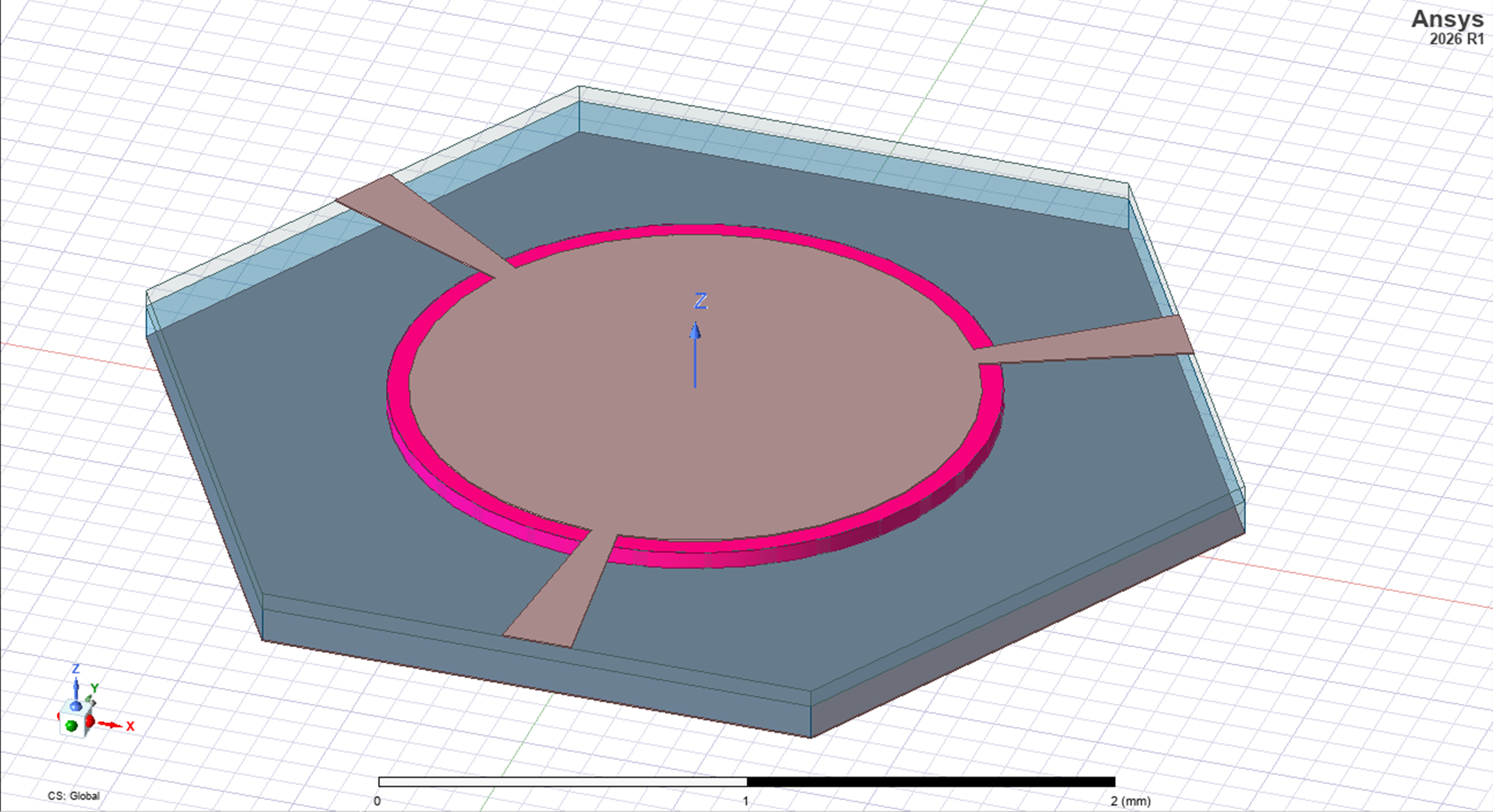
Caption figure 2: Simulation results, showing insertion loss (light blue), return loss (green) and isolation loss (blue)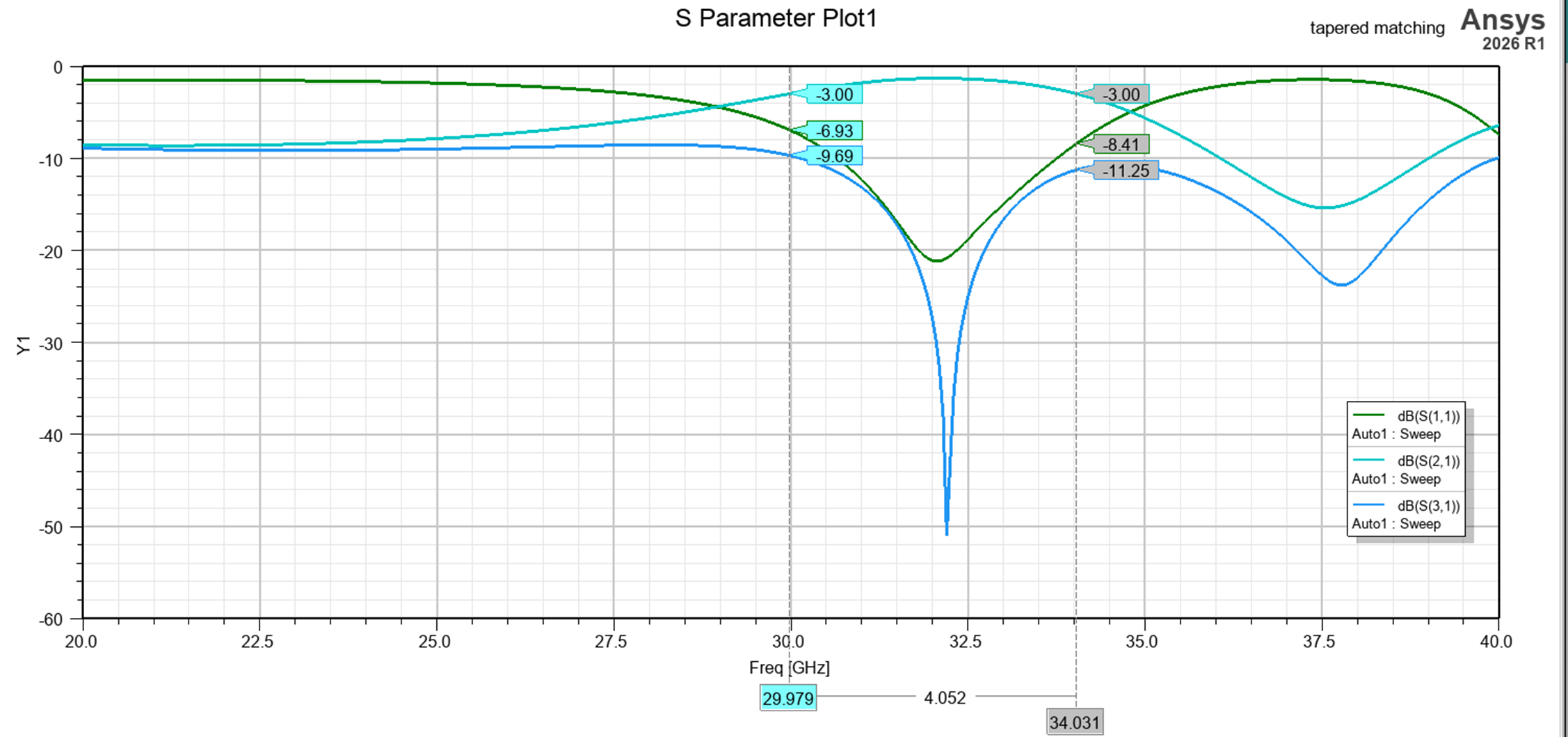
Photo credits: Atefeh Kordzadeh
Scientific contacts and contributors
Luiz Guilherme Enger, Silicon Austria Labs
Atefeh Kordzadeh, Silicon Austria Labs
Shraddha Choudhary, Silicon Austria Labs
Explore FAMES technologies
Find out more about FAMES Power Management of Integrated Circuits


