
Tyndall Demonstrates First-Ever Tether-Free Micro-Transfer Printing of Si-based Micro-Inductors chiplets
Tyndall achieves a world-first in heterogeneous integration of magnetic micro-inductors, demonstrating tether-free micro-transfer printing onto glass substrates and into silicon trenches for next-generation PowerSoC applications. Results presented at ECTC 2026.
The Challenge: Getting Magnetics Off the Board and Into the Package
Advanced power delivery for high-performance computing and PowerSoC applications demands that passive components, especially power inductors, be placed close to active devices. Conventional back-end-of-line (BEOL) integration is constrained by CMOS thermal budgets and limited metallization thickness, making it very difficult to achieve adequate inductance density and current handling monolithically.
Heterogeneous integration offers a compelling alternative: fabricating inductors independently with optimised materials and thick copper, then transferring them onto target substrates, bypassing BEOL constraints entirely. The missing piece has been a scalable transfer method that works with commercially fabricated components without complex sacrificial structures.
The FAMES-Enabled Breakthrough
Within the FAMES project, our team developed a tether-free micro-transfer printing approach that eliminates sacrificial tether structures traditionally required in transfer printing. Discrete micro-inductors (1.5 mm × 0.5 mm) on 100 mm wafers were thinned from 525 µm to just 60 µm using partial saw-dicing followed by backside grinding, then micro-transfer printed to both glass and silicon substrates using custom-designed PDMS stamps. This is a significant advancement beyond the previous state-of-the-art demonstration of 250 µm-thick micro-inductor transfer-printing.
Two Integration Routes Demonstrated
We successfully demonstrated two distinct heterogeneous integration approaches. First, thinned micro-inductors were transfer-printed onto glass substrates, enabling immediate deployment in 2.5D/3D integration and glass interposer platforms. Second, inductors were embedded into pre-etched 130 µm-deep silicon trenches, representing the first-ever in-substrate integration of magnetics-on-silicon through tether-free micro-transfer printing. This trench-embedding approach eliminates surface-area consumption and shortens current return paths for compact power delivery networks.
Electrical characterisation from 10 MHz to 10 GHz confirmed excellent preservation of inductor performance across both integration routes. Inductance was maintained within ±10% of as-fabricated values (6.94 nH pre-process, 6.44 nH post-transfer), with no shift in inductive roll-off behaviour. Substrate choice had minimal impact on performance, validating that the tether-free approach and aggressive thinning to 60 µm do not degrade the magnetic or electrical properties of the devices.
Impact and Next Steps
This work establishes a scalable route toward fully embedded, substrate-level power delivery for next-generation PowerSoC systems. The tether-free approach enables known-good-die assembly and is compatible with both glass and silicon interposers, making it directly applicable to chiplet-based architectures. The next step within FAMES is co-embedding inductors alongside capacitor chiplets within silicon interposer substrates enabling fully integrated dc-dc converter development.
Additional links or documents
ECTC 2026 Paper: “Tether-Free Micro-Transfer-Printing of Si-based Micro-Inductors: Demonstration of on-Glass and in-Silicon Integration for PowerSoC Applications”
Illustrations:
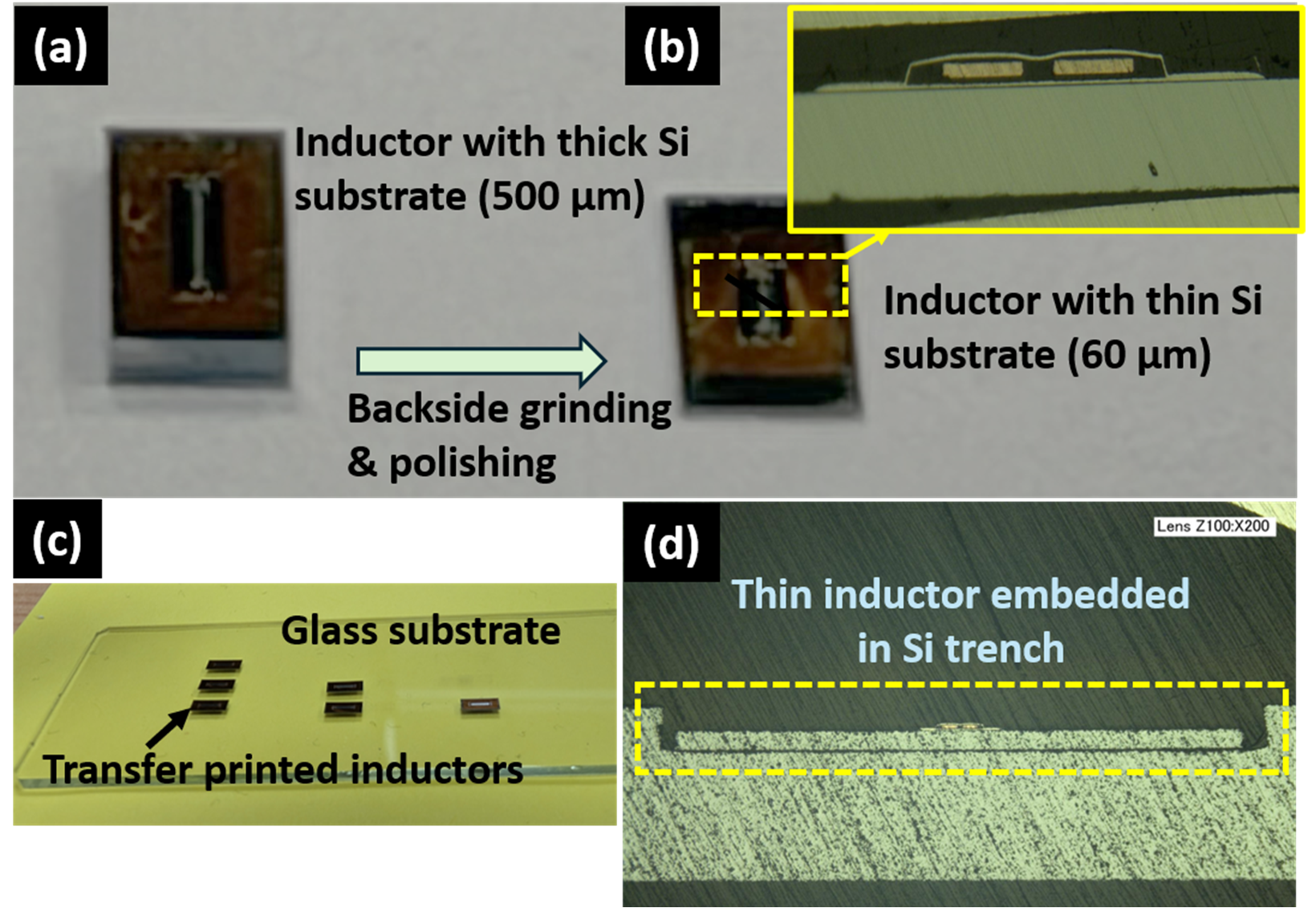
Figure 1: (a) Fabricated micro-inductor on a ~500 µm-thick silicon substrate, (b) Micro-inductor after backside grinding and polishing, ~60 µm-thick Si substrate (inset: cross-section of an inductor), (c) Thinned inductors transfer-printed onto a glass substrate, (d) An ultra-thin micro-inductor transfer-printed inside a silicon trench.
Scientific contacts and contributors
Sambuddha Khan, FAMES Programme Manager, Tyndall
Contact person for follow-up
Sambuddha Khan ; Cian O’Mathuna ; Rayan Bajwa ; Amit Tanwar
Explore FAMES technologies
Find out more about FAMES Power Management of Integrated Circuits


